
The above and lower archeological findings come from the Wulpinski lake near Dorotow and were found in one place. They were donated by Mirek Jerozolimski a school friend. The area where these were uncovered is very well known to me.
The three corner sandstone. Stone of this structure is not found in Warmia and Mazury, the left side measures 10.5 cm. in comparing with other sides it could have been embedded in a wood or a tree branch, and for sure this tool was attached to a wooden handle. The smooth and and regular sides indicate that this tool was made by man for personal use. The question is from what era is it, from where did it come and are there other and similar findings. Possibly archeologists will be able to tell us much more on this subject and eventually pinpoint to what culture this finding belongs to.

It resembles the one above and is also made of sandstone. The difference from the first one is that the left side is sharp. The sharpness is not in the middle, but is on the lower part of the flatness. It could have been used for tanning hides or chopping meat.

This stone is of granite. The left side was evidently used and is dull. The even structure of this stone indicates that this finding belonged to man and was used for his needs.
Thanks to kindness of Dr Miroslaw Hoffmann an archeologist it was possible to visit an excavation site from late iron period III - IV century BC.
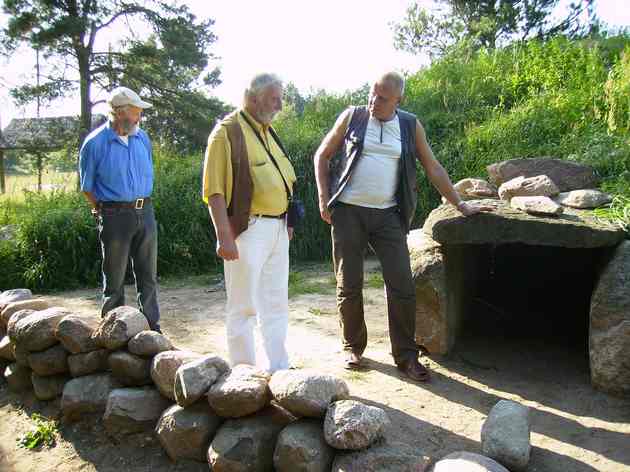
Mound with burial stone compartment. Sambia region III - IV century BC.
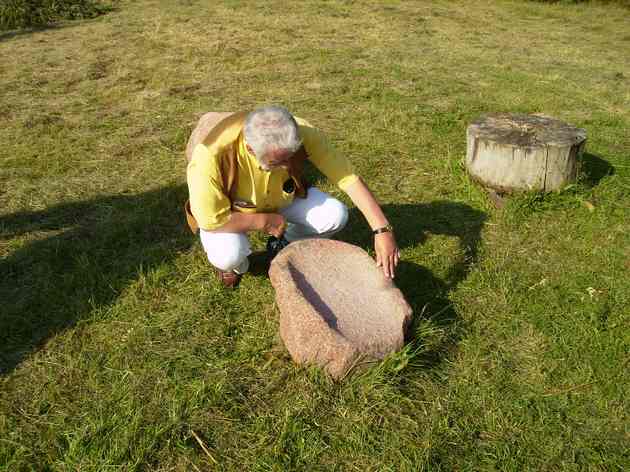
Stone used for flour milling. Neolit period. Was used from 4000 years ago to early middle ages.
I would like you to notice the possibility of other use than only as the flour mill.
It can be seen, that flour mill is damaged, the kneading-trough. Fingers pointing out a notch on the side of the kneading-trough. When flour mill was complete the notch was right in the middle.
Apart of grinding wit for flour the flour mill could be used for bread preparation, cakes, because of stone structure could easily be washed, thus guaranteeing hygiene.
It also can be assumed that it served for the meat preparation, partitioning before grilling.
Further, emptying birds, fish, for sure was used. Any excess of liquid or water used for washing up could easily be discharged over the side notch.
Also necessary,to pay attention for the skill of workmanship, symmetry of the oval shape and the depth of it, shows a great accuracy.
Slav
Klec Pilewski
Back to Top »